
Archetypes
Your face has a type, and it isn’t the same thing as your score.
Two people can measure the same harmony score and look nothing alike. Archetype describes the shape of your measurements — and it's the part that decides what actually suits you.
Menua Vardanyan · Published · Updated
Why the score isn’t enough
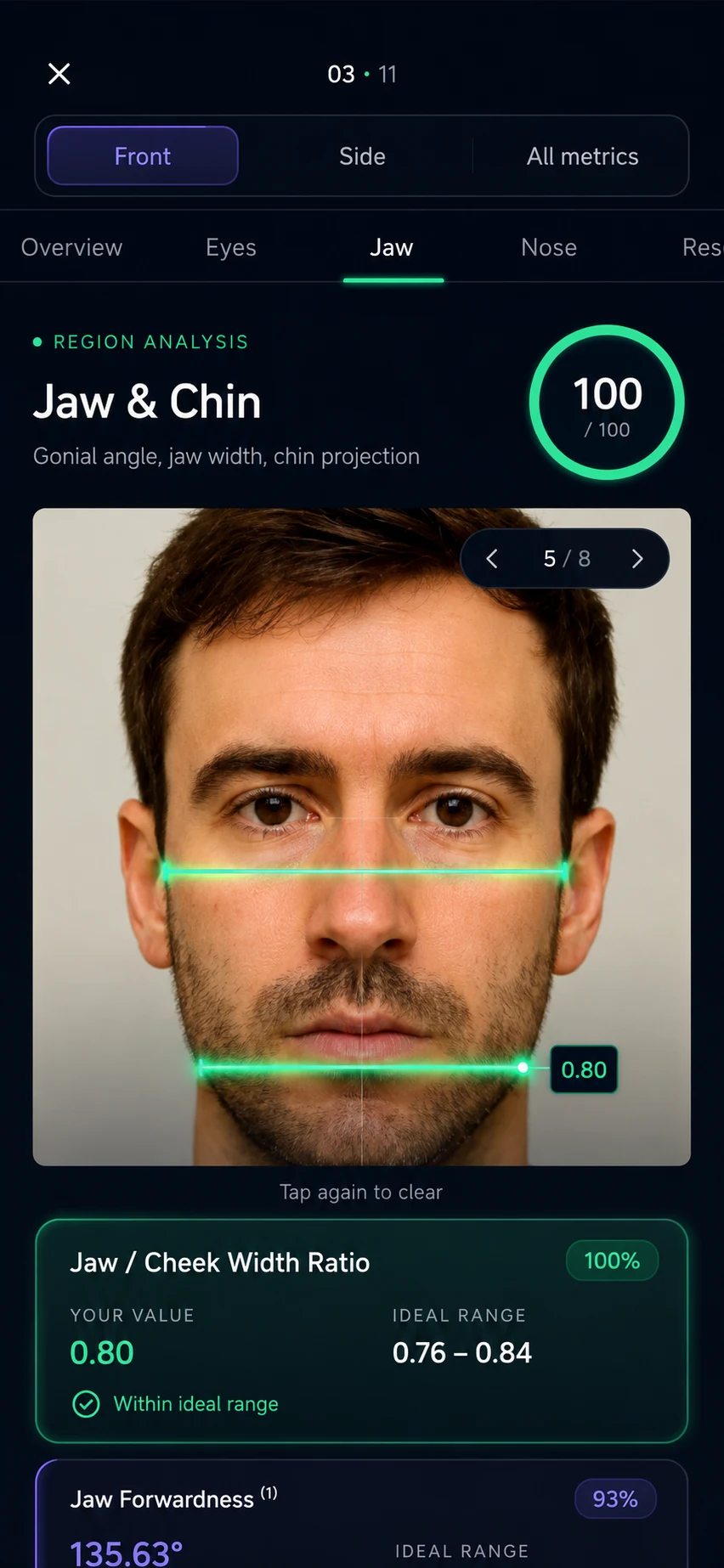
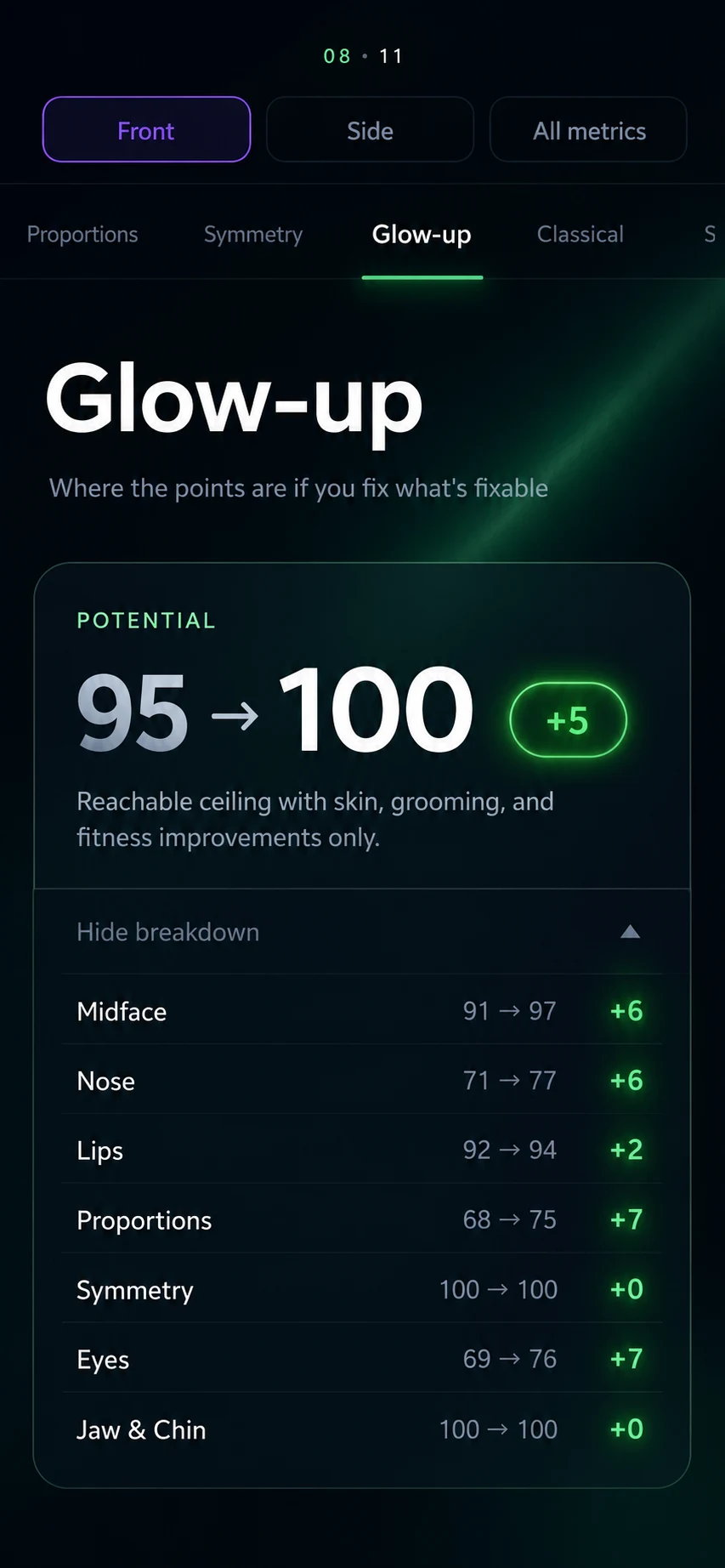
A harmony score compresses 75 measurements into one number. That is useful for tracking, and useless for deciding what to do on a Tuesday morning. Two faces at the same score can have opposite strengths — one angular with weak skin, one soft with excellent proportions.
The archetype keeps that information. It reads the pattern: which clusters run high, which ratios sit at the edges of their ranges, and how the jaw and midface measurements relate to each other.
The six archetypes
| Archetype | Driven by | How it reads |
|---|---|---|
| Hunter | Deep-set eyes, positive canthal tilt, strong gonial angle, high FWHR | Angular and intense. The look the community means by "hunter eyes". |
| Classic | Measurements clustered near the centre of their ranges, high symmetry | Balanced and conventional. Few outliers in either direction. |
| Soft | Rounder midface, lower FWHR, fuller lips, gentler jaw angles | Approachable and youthful rather than angular. |
| Striking | One or more measurements far outside their range, in a way that reads distinctive | Memorable rather than average. Unconventional by measurement. |
| Boyish | Shorter lower-face percentage, softer mandibular plane, larger eye-to-face ratio | Younger-reading proportions. |
| Mature | Longer lower third, more defined jaw and chin projection | Older-reading, more structurally developed proportions. |
Classification is rule-based and deterministic — the same measurements always produce the same archetype.
Why it changes what you should do
Most appearance advice is written for an average face that is nobody’s. Archetype is what makes it specific:
- Hair and grooming. Volume and framing that soften an angular face will flatten a soft one.
- Body composition. A soft archetype usually sees the largest visible change from losing facial fat; an already-angular one sees less.
- Where to stop. Chasing a Hunter look with a Boyish skeleton is the single most common way people waste a year.
None of this is a ranking. Archetype is a description, and the useful response to it is choosing what suits you rather than working against your own structure.
Related: how the harmony score is built, how it maps to PSL tiers, and turning it into a routine.
Common questions
What is a face archetype?
A description of the pattern your measurements form, rather than how high they score. Two people can share a harmony score and have completely different archetypes because the measurements sitting outside their ranges are different ones.
How does GlowAI decide my archetype?
A rule-based classifier reads the pattern across your 75 measurements — which clusters are strong, which ratios sit high or low, how angular the jaw and midface measurements are. It is deterministic, not an AI guess, and it is derived from the same measurements as your score.
Is one archetype better than another?
No. Archetype is orthogonal to score — you can be Apex-tier Soft or below-average Hunter. What it changes is what suits you: grooming, hair and styling choices that flatter an angular face often work against a soft one, and vice versa.
Can my archetype change?
Slightly, and mostly through body composition. Losing facial fat tends to move measurements toward the angular end; gaining it moves them back. The underlying skeletal pattern does not change without surgery.
Sources
Ideal ranges are taken from published anthropometric literature. Every metric in the app carries its own citation; these are the works the set is built on.
- Farkas LG. Anthropometry of the Head and Face. 2nd ed. Raven Press, 1994. (opens in a new tab)
The reference dataset for human craniofacial measurement — the source of most normative ranges in use today.
- Powell N, Humphreys B. Proportions of the Aesthetic Face. Thieme-Stratton, 1984. (opens in a new tab)
Defines the profile angles — nasofrontal, nasofacial, nasomental, mentocervical — used in the side-profile analysis.
- Naini FB. Facial Aesthetics: Concepts and Clinical Diagnosis. Wiley-Blackwell, 2011. (opens in a new tab)
Modern synthesis of facial proportion assessment, and the source for several vertical-thirds and horizontal-fifths ranges.
- Sarver DM. Esthetic Orthodontics and Orthognathic Surgery. Mosby, 1998. (opens in a new tab)
Soft-tissue analysis — lip projection, smile arc and incisor display.
- Mommaerts MY, et al. Published work on facial proportion and orthognathic planning. (opens in a new tab)
Contemporary maxillofacial ranges, including midface and chin projection.
Get your face score. It takes 30 seconds.
Free first scan on iPhone and Android. See the numbers before you decide anything.