
Face rating
A face rating is only useful if you can see the working.
Any app can return a number between 1 and 10. The question worth asking is what produced it — and whether anything in the result tells you what to do next.
Menua Vardanyan · Published · Updated
Why most face ratings are meaningless
A rating with no visible method has three problems at once. You can’t verify it, you can’t reproduce it, and you can’t act on it. It’s a vibe rendered as a decimal.
The tell is simple: if an app gives you a score but can’t show you which measurements produced it, there’s nothing underneath to inspect.
What a defensible score requires
- Named metrics. Specific, measurable quantities — not adjectives.
- Published reference ranges. Each metric compared against a documented ideal range from anthropometric research, with the citation attached.
- Reproducibility. Two scans under the same conditions should land in the same place.
- Actionability. The result has to separate what you can change from what you can’t.
How GlowAI builds its harmony score
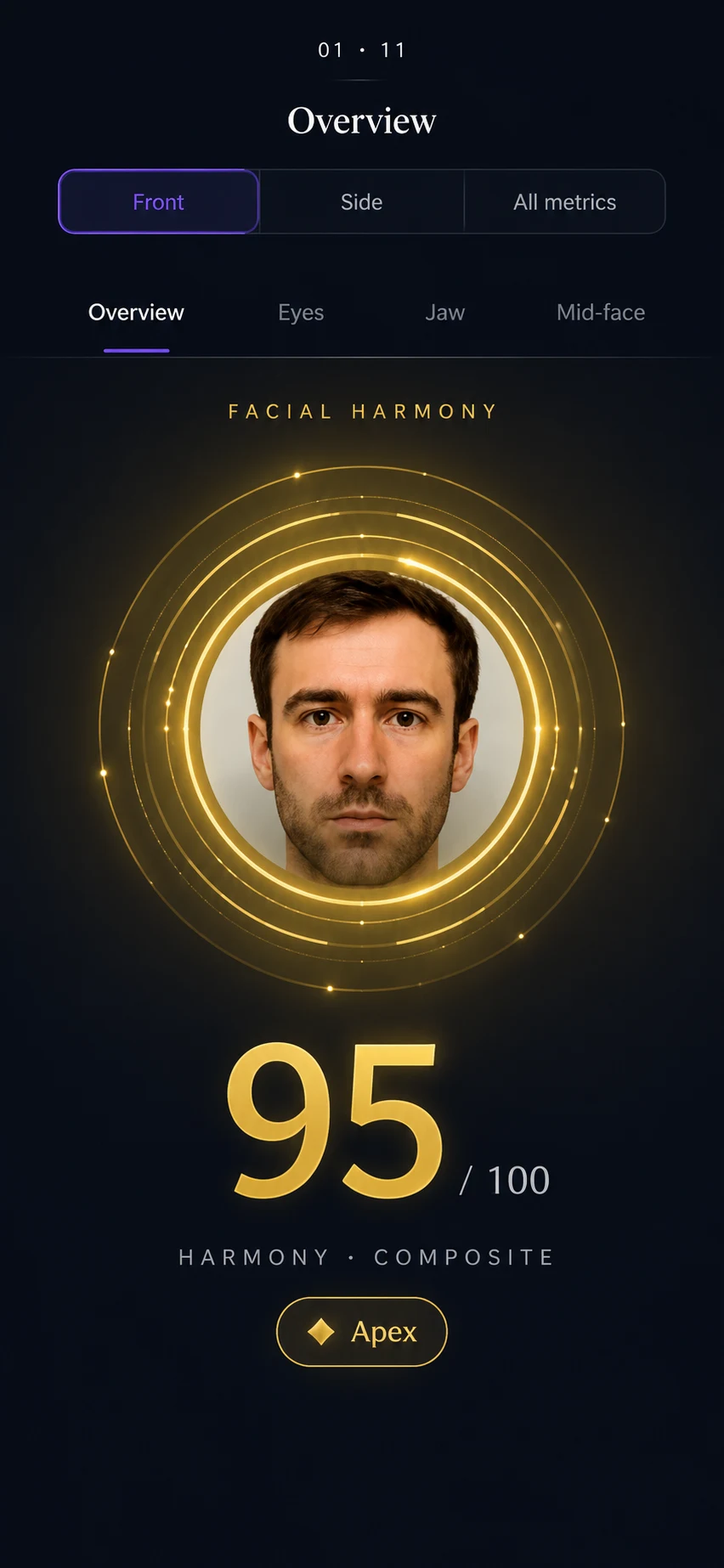
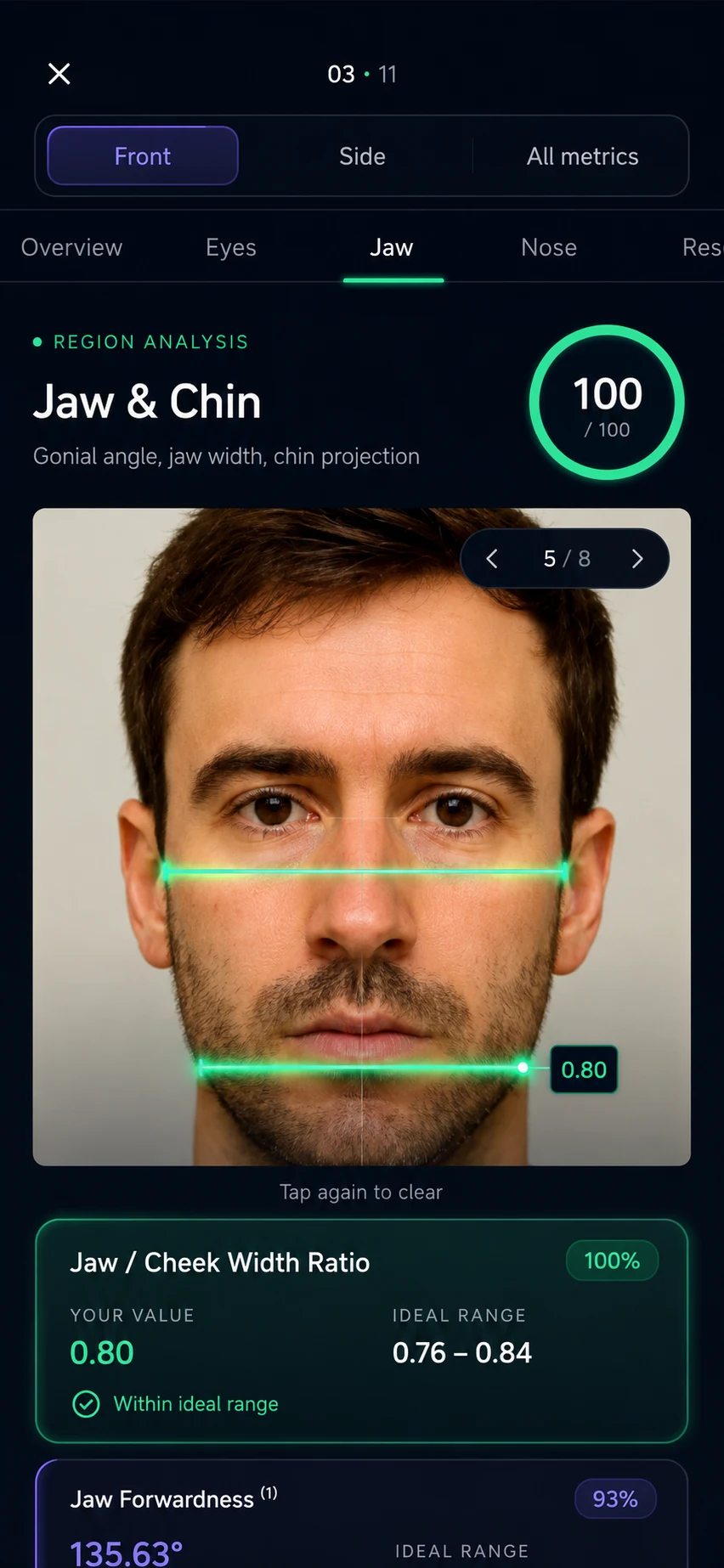
75 measurements are taken from a front photo and a side profile, each compared against ideal ranges drawn from published work by Farkas, Powell, Naini, Sarver, Goode and Mommaerts. Every metric in the app carries its citation. Those individual results then roll up into a single composite:
| Metric | Example reading | Reference range |
|---|---|---|
| Canthal tilt | 6.2° | Ideal 4–8° |
| Facial width-to-height | 1.87 | Ideal 1.65–2.05 |
| Jaw / cheek width ratio | 0.82 | Ideal 0.78–0.86 |
| Gonial angle | 126° | Ideal 120–130° |
| Midface ratio | 1.02 | Ideal 0.95–1.15 |
| Bilateral symmetry | 0.98 | Ideal 0.97–1.00 |
| Your harmony score | 78.4 | Composite, 0–100 |
The composite at the bottom is the score people screenshot. The five rows above it are the reason it means anything.
How to read your score without wrecking your week
A harmony score describes how your proportions compare to population averages. That’s all it does. It is not a measure of how attractive you are, and it has nothing to say about how you come across to another person — expression, warmth and grooming carry enormous weight that no static ratio captures.
The useful move is to ignore the headline number after the first look and go straight to the ranked list of fixable metrics. That list is where the score stops being a rating and starts being a plan.
Next: how the scan itself works, or how those metrics become a daily routine.
Common questions
Are face rating apps accurate?
It depends entirely on whether the app is measuring or guessing. An app that outputs a number with no visible metrics behind it cannot be checked, so its accuracy is unknowable. An app that shows each measurement and the published range it was compared against can be verified — you can re-scan and confirm the numbers land in the same place.
How is a facial harmony score calculated?
In GlowAI, 75 individual measurements — angles, ratios and distances across the eyes, nose, lips, jaw, chin and profile — are each compared against ideal ranges from published anthropometric literature. Those individual results roll up into one composite score from 0 to 100.
Is a face rating the same as attractiveness?
No. A harmony score measures geometric relationships against population averages. Attractiveness involves expression, grooming, symmetry in motion, personality and context — none of which a static measurement captures. Treat the score as a description of proportions, not a judgment of you.
Can I improve my face rating?
Partly. Metrics driven by skin quality, body composition, grooming, hydration and sleep respond to consistent effort. Metrics driven by skeletal structure do not change without surgery. GlowAI marks which is which so you are not spending months on something a routine cannot move.
Sources
Ideal ranges are taken from published anthropometric literature. Every metric in the app carries its own citation; these are the works the set is built on.
- Farkas LG. Anthropometry of the Head and Face. 2nd ed. Raven Press, 1994. (opens in a new tab)
The reference dataset for human craniofacial measurement — the source of most normative ranges in use today.
- Powell N, Humphreys B. Proportions of the Aesthetic Face. Thieme-Stratton, 1984. (opens in a new tab)
Defines the profile angles — nasofrontal, nasofacial, nasomental, mentocervical — used in the side-profile analysis.
- Naini FB. Facial Aesthetics: Concepts and Clinical Diagnosis. Wiley-Blackwell, 2011. (opens in a new tab)
Modern synthesis of facial proportion assessment, and the source for several vertical-thirds and horizontal-fifths ranges.
- Sarver DM. Esthetic Orthodontics and Orthognathic Surgery. Mosby, 1998. (opens in a new tab)
Soft-tissue analysis — lip projection, smile arc and incisor display.
- Mommaerts MY, et al. Published work on facial proportion and orthognathic planning. (opens in a new tab)
Contemporary maxillofacial ranges, including midface and chin projection.
Get your face score. It takes 30 seconds.
Free first scan on iPhone and Android. See the numbers before you decide anything.


Keep reading
- AI face scan app — how the measurement worksTwo photos, 75 measurements, and the published range behind each one.
- Looksmaxxing app — the measured versionTurning the score into a routine, and separating fixable from fixed.
- PSL rating — every tier explainedSub3 to True Adam, derived from measurements rather than votes.